
Article by Kyle Ruef, PE, PMP, CCM, Chief Operating Officer at Vierbicher
The recent headlines bring welcome news for local leaders across Wisconsin and Wisconsin’s smaller communities. Governor Evers and the Wisconsin Department of Transportation recently announced that counties and municipalities have received over $180 million in the third quarterly installment of the 2026 General Transportation, Connecting Highway, and Expressway Policing Aids. This historic push brings total calendar-year support to over $570 million—marking the largest annual allocation for the General Transportation Aids (GTA) program in state history.
Having spent a significant portion of my career leading public infrastructure projects and managing public works portfolios, I look at these historic numbers with an eye for what happens next. This funding represents an incredible win for our communities, but I know that securing a grant is only half the battle. The real achievement lies in project execution.
Wisconsin’s smaller communities are some of the most innovative and efficient entities in our state. They stretch local tax matches, maintain critical infrastructure with lean teams, and intimately understand their local geographic needs. Yet, a sudden influx of capital introduces an immediate puzzle: how do you execute complex site developments and municipal infrastructure upgrades within strict regulatory windows, strict budget boundaries, and the reality of a compressed Upper Midwest construction season?
Infrastructure Project Execution in Wisconsin’s Smaller Communities
Being a trusted partner to help in the execution of public infrastructure is about understanding your community’s specific goals, objectives, and constraints, and working as an extension of your team to cross the finish line smoothly. To turn historic capital into concrete project success without overextending local resources, we prioritize three practical pillars:
1. Rooting Designs in Financial Pragmatism
Every community has a vision for growth, whether it is an expanded business park or a completely rehabilitated downtown corridor. But an engineering plan is only as good as the budget supporting it. True partner alignment means looking closely at your long-term operational costs and debt service boundaries before a single layout line is drawn. We help local leaders balance what is desirable with what is structurally and financially responsible, ensuring that projects generate long-term value without straining the municipal levy.
2. Synchronizing Projects to Stretch Capital
Smaller communities face a complex web of modern regulatory mandates, from the Wisconsin DNRs strict compliance tracks for safe drinking water to mandatory Lead Service Line (LSL) replacement inventories. When a community is utilizing newly announced state funds to reconstruct a roadway corridor, treating the utility network and the street as isolated projects can lead to duplicate expenses. True fiscal stewardship means finding synchronicity. By integrating utility upgrades directly into the highway footprint under a single, unified project framework, we help communities eliminate redundant mobilization fees and maximize their state funding positioning.
3. Protecting the Local Economy During Construction
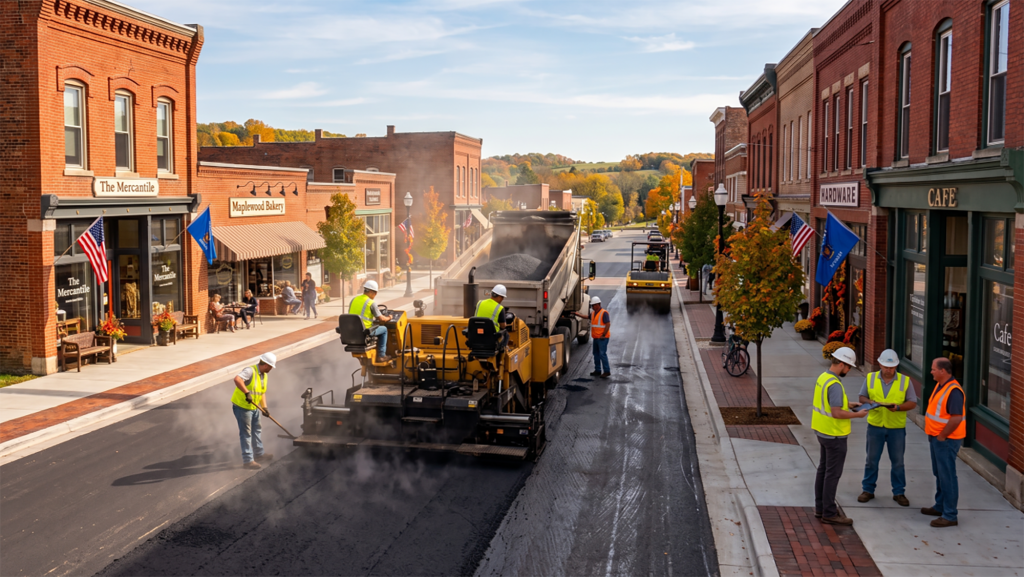
In our smaller cities and villages, a public works project isn’t just an engineering task—it directly impacts community residents and local businesses. Because our teams share a commitment to local client relations and teamwork, we prioritize the local economy throughout the execution process. True alignment means designing construction staging plans around seasonal business cycles, coordinating traffic shifts to protect local commerce, and ensuring clear public communication so residents remain engaged and informed.
The Public Sector Truth: Public service is built on predictability and accountability. Credibility isn’t won by talking about complex technical capabilities; its earned by listening closely to a community’s needs, honoring your commitments, and delivering a project that functions perfectly within the exact funding constraints you were given.
One Team for a Resilient Tomorrow
To the village administrators, city managers, and public works crews working tirelessly across Wisconsin: this funding provides an unparalleled opportunity to secure your community’s future. You don’t need a massive internal engineering department to deliver beautiful, reliable infrastructure projects. You already possess the local vision and dedication. The role of a trusted municipal engineering partner is simply to provide the foundational knowledge, regulatory insight, and technical horsepower needed to guide your projects from an allocation line item to a finished physical asset.
Let’s Connect: How is your community planning to optimize its project delivery and maximize the 2026 GTA funding? Let’s connect on how Vierbicher can help your team align your upcoming municipal public works or site development initiatives.